
Finding Your API's Breaking Point
How to systematically find where your API fails under load — the process, what to look for, and what to do with that information.
Every system has a breaking point. The question is whether you find it in testing or your users find it in production.
Stress testing is about intentionally pushing past normal limits to discover where things fail. Not if. Where. The stress testing vs load testing comparison explains when each approach makes sense.
The process
Start with a baseline. Run a load test at your expected traffic level. Document the results — throughput, latency, error rate. This is your "normal." The performance baselines guide covers how to establish and track these.
Then increase load. Double the concurrency. Run again. Compare to baseline. Still looking good? Double again.
Keep going until something breaks. Latency spikes. Errors appear. Throughput plateaus. That's your breaking point.
What "breaking" looks like
It's rarely dramatic. Servers don't usually explode. Instead, you see gradual degradation that suddenly becomes severe.
Latency cliff — response times are steady, steady, steady, then jump 10x. You hit a resource limit. Queue times dominate.
Error spike — error rate goes from 0.1% to 20% within a small load increase. Something ran out. Connections, memory, threads.
Throughput plateau — you keep adding load but RPS stops increasing. You're saturated. More requests just wait longer.
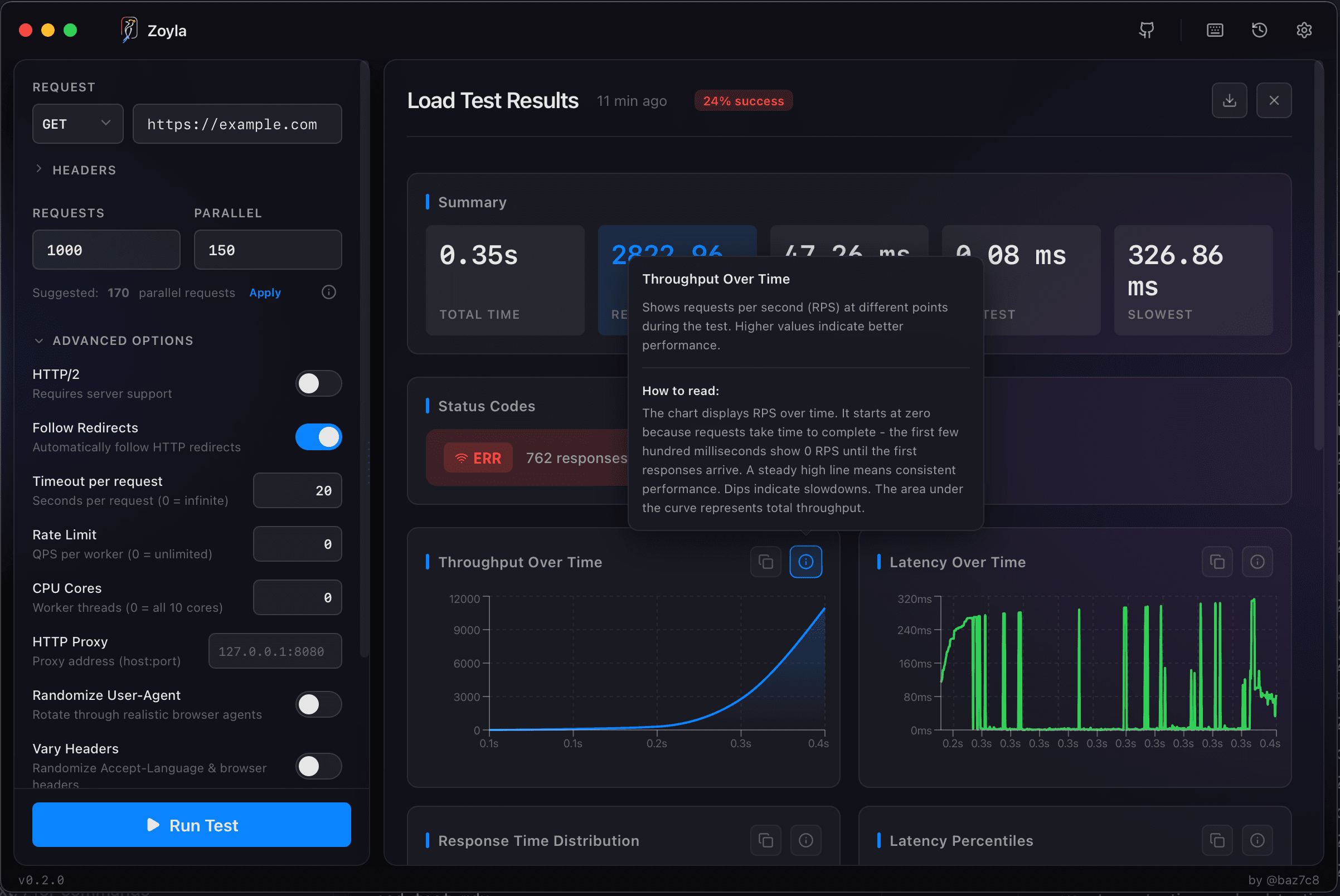
Sometimes you see all three at once. Sometimes one appears before the others. The pattern tells you something about what's failing.
Finding the exact threshold
Once you know roughly where things break, narrow it down. If 100 concurrent users is fine and 200 breaks, test 150. Then 175 or 125 depending on results.
This precision matters for capacity planning. "We break somewhere between 100 and 200 users" is less useful than "we break at 165 users."
Zoyla makes this iteration fast. Adjust concurrency, run again, see results immediately. You can dial in the threshold in a few minutes.
What's actually failing
The breaking point tells you where. Figuring out why requires more investigation.
Check your server metrics during the test. CPU maxed out? That's your limit. Memory exhausted? Different problem. Database connections at maximum? There's your bottleneck. The monitoring during load tests guide covers what to watch.
Common culprits:
- Database connection pool exhausted
- Thread pool full
- Memory pressure triggering garbage collection
- CPU saturation on compute-heavy endpoints
- External service timeouts cascading
Knowing which resource fails first tells you where to focus optimization or scaling. If the database is your bottleneck, the database bottlenecks guide covers what to look for.
What to do with this information
Set capacity limits — if you break at 500 RPS, don't promise 600. Build in margin. The capacity planning basics guide shows how to translate these numbers into infrastructure decisions.
Plan scaling triggers — know when to add capacity before you hit the wall.
Prioritize optimization — the first thing to fail is the first thing to fix.
Design graceful degradation — if you know where you break, you can shed load before you get there.
The safety margin question
How much headroom do you need? Depends on your traffic patterns.
Steady, predictable traffic? 20% margin might be enough.
Spiky traffic with sudden surges? You might need 2x or 3x headroom.
Mission-critical with zero tolerance for degradation? More margin, or auto-scaling, or both.
Regular retesting
Your breaking point changes. New code, new features, data growth, dependency changes. What broke at 500 RPS last month might break at 400 now. Or 600.
Retest periodically. After major releases. After infrastructure changes. When you're planning for known traffic events.
For more on timing, see when should you actually load test.
The mindset
Finding the breaking point isn't failure. It's information. Every system has limits. Knowing yours lets you work with them instead of being surprised by them.
Break your system on purpose, in controlled conditions, so your users don't break it for you.
Ready to find your limits? Download Zoyla and start stress testing in minutes.